

The skills system in England is complex, in terms of the scope and scale of qualifications, the commissioning of funding of courses and training including apprenticeships. There is also often a lack of connection between employment demand and government funded/supported skills provision.
To gain a better understanding of the picture on a local level, we commissioned the Institute for Employment Studies (IES) in partnership with Rocket Science to deliver insights into skills demand and supply in the West London labour market.
Read the final project report, explore the data using the interactive dashboard tool or watch the webinar recording for a run through of the tool.
Project overview
Seeking to build on existing analysis, IES and Rocket Science worked to draw together demand and supply data for West London ensuring it was as accessible and coherent as possible to ensure data could be easily updated.

Supply
To explore skills provision, data on courses was collected from all FE colleges across the West London Alliance boroughs, including course names, subject areas, qualifications, level, duration and places. Courses were then matched against the Standard Occupational Classifications (SOC) and Standard Industrial Classifications (SIC) used by the ONS.

Demand
Based on a review of existing data sources and given the requirements for easily replicable and transparent forecasts, data from the Annual Population Survey (APS) was used to get historic data for jobs by industry and occupation. Regression analysis was applied to predict employment trends for 2020-2030. Data from 2020 was used to adjust the forecasts for changes arising due to Covid-19.
Both data sources were then brought together in an interactive online tool that maps the skills supply against demand. It allows users to interrogate and filter the data by course provider, local authority, sector subject area, occupation and NVQ level. The tool also has the capacity to analyse forecast demand by sector subject area as a yearly average of demand for employment over the period 2021-2030.
Main Findings
Employers’ skills demand
- The number of people working in the West London area increased by 111,000 (12%) between 2010 and 2019, however, this was lower than the growth rate in London (23%). This growth was predominantly amongst the higher skilled occupational group.
- A forward projection of historical employment trends not adjusted for Covid-19 suggests that employment could have grown to around 1.2m by 2029, equating to growth of 13%, slightly below that forecast for London as a whole (16%).
- While there have been notable reports of redundancies and job losses, the longer-term effects of Covid-19 on employment in London and West London are anticipated to be relatively low, with West London employment in 2029 at a level around 4.6% lower than under a no Covid-19 scenario.
- Growth will continue for skilled/higher level occupations and with most occupations growing in absolute terms, a decline is predicted in administrative/secretarial occupations (-25%) and skilled trades (- 8%) compared with 2020 – resulting from the fall-out from Covid-19 anticipated during 2021.
- Overall levels of demand are anticipated to remain at a similar level for much of 2020-29 (following the fall in 2021).
Skills supply
- The six FE colleges in West London currently offer a total of 1,296 courses with 18,780 places available.
- The highest number of places is in Health, Public Services and Care (3,148, 16.7%), while the sector with the lowest number of places is Education and Training (546, 2.9%).
- The proportion of Level 2 and Level 3 places varies by sector. Retail and Commercial Enterprise has the highest proportion of Level 2 places (68.4%); Science and Mathematics has the highest proportion of Level 3 places (78%).
Gaps between demand and supply
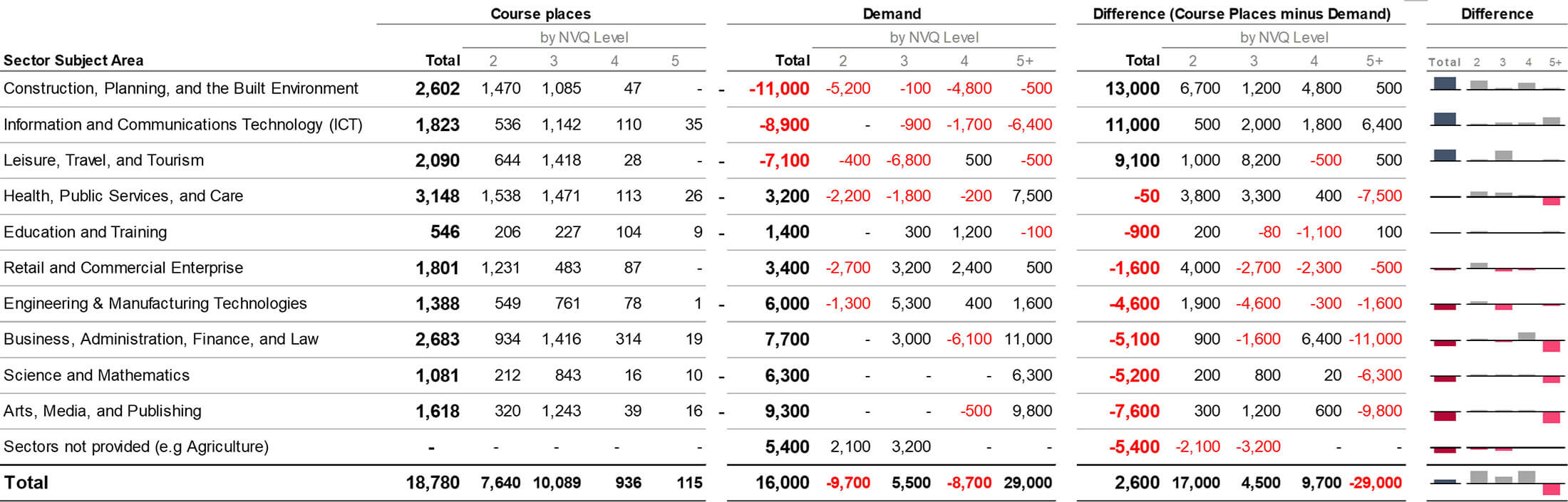
The impact of the end of the Brexit transition period and COVID-19 pandemic on employment has had a marked impact on the demand forecasts for 2021. Overall, the number of places (18,780) exceeds demand for jobs (16,160) across the WLA area. This is largely because of the negative demand in three sectors:
- Construction, Planning, and the Built Environment (forecast 2021 demand: -10,541)
- Information and Communications Technology (forecast 2021 demand: -8,941)
- Leisure, Travel, and Tourism (forecast 2021 demand: -7,056)
Figure 8.1: Detailed breakdown of course places against 2021 forecast demand by SSA and NVQ Level
More detailed findings about longer term trends and gaps between supply and demand can be explored through the tool itself or in the full report.
Outputs
As part of the project, two main outputs were produced.
- A full report summarising the main findings and providing details on the methodological approach and data sources used.
- An interactive online tool mapping skills supply and demand in West London allowing users to interrogate the data further using filters. You can watch this webinar for a quick run through of the tool.


Newsletter sign up
Sign up for our quarterly newsletter to learn more about our work and West London’s priorities.